Summary
Neither Hold & Win nor cascading reels automatically pays more often. The individual slot’s mathematics – not its headline mechanic – determine payout frequency, theoretical return, and volatility.
- Hold & Win features typically lock prize symbols during respins. More coin landings or resets do not guarantee a large payout.
- Cascading reels can produce several awards from one paid spin. Those awards may still total less than the original stake.
- Hit frequency is not profit frequency. Receiving an award does not necessarily mean finishing the round ahead.
- RTP and volatility measure different things. A high-return game can still produce substantial short-term losses.
- Bankroll longevity depends on stake size, game mathematics, play speed, and spending limits – not the feature’s name.
- Check the actual game rules and provincial operator authorization before playing. Neither mechanic provides dependable profits.
Hold & Win vs. Cascading Slots: Payout Frequency and Volatility Explained
Neither Hold & Win nor cascading reels automatically pays more often. Payout frequency depends on the mathematics of the individual slot, not simply its headline feature.
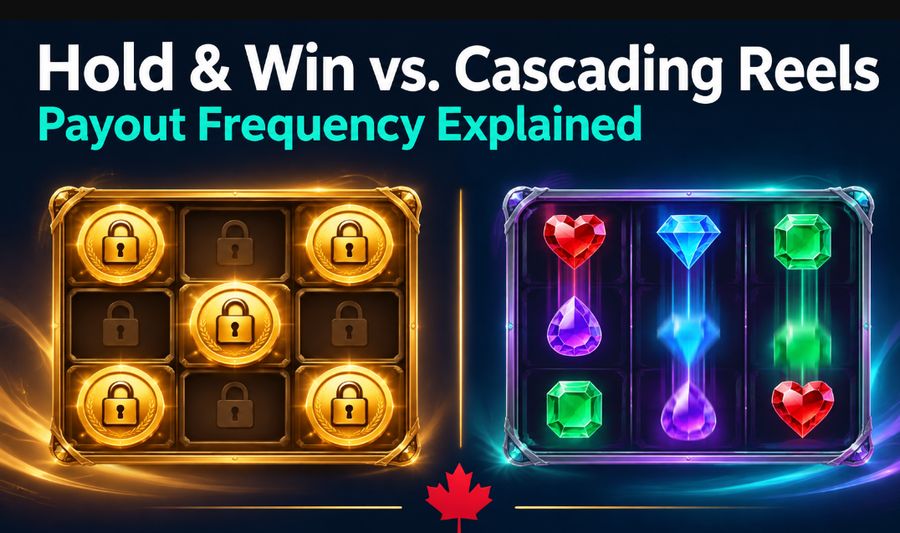
Cascading slots can produce several winning events from one paid spin. Hold & Win features typically lock prize symbols in place during a respin sequence. Both can create extended animations, but neither guarantees frequent profitable rounds or a longer-lasting bankroll.
The most important distinction is between receiving an award and finishing a round ahead. A slot can return small amounts regularly while still reducing your balance.
For Canadian players comparing games, the useful questions are specific: What counts as a hit? How often does the bonus trigger? How much return sits in the base game? What does the entire round cost?
This guide connects those questions to slot volatility, RTP, and bankroll longevity. It compares documented mechanics rather than inventing payout statistics or treating a short demonstration session as proof of performance.
Hold & Win vs. Cascading Reels at a Glance
| Comparison point | Hold & Win | Cascading reels |
|---|---|---|
| Main function | Holds qualifying symbols during a feature | Removes winning symbols and introduces replacements |
| Typical presentation | Locked coins, prize values, respins | Consecutive wins, tumbles, reactions |
| Where it appears | Often a bonus, although structures vary | Base game, free spins, or both |
| Multiple events from one stake | Possible during the feature | Possible within a cascade sequence |
| Guaranteed higher hit frequency | No | No |
| Guaranteed lower volatility | No | No |
| Main comparison risk | Confusing bonus activity with frequent paid-spin returns | Counting every cascade as a separate profitable spin |
These mechanics are not mutually exclusive. A slot can combine different feature types.
A fair comparison must therefore use the complete game rules, not just the labels displayed in the lobby.
What Is a Hold & Win Slot?
Hold & Win usually describes a feature in which qualifying symbols remain fixed while other positions continue spinning.
A common structure begins with a limited number of respins. New qualifying symbols can reset the counter, and the feature ends when the counter expires or another completion condition is met.
However, the precise rules differ.
Check:
-
Which symbols trigger the feature.
-
How many respins are awarded.
-
What resets the counter.
-
How symbol values are calculated.
-
Whether collectors or multipliers apply.
-
What happens when the grid fills.
-
Whether a maximum-win cap ends the round.
Playson’s 3 Thunder Coins: Hold and Win provides one documented example: a qualifying combination involving the Thunder Coin triggers a bonus with three respins.
That does not establish that every Hold & Win game uses identical entry or reset rules.
What Are Cascading Reels?
Cascading reels replace winning symbols with new symbols after an award.
Depending on the game, the process may be called tumbling, collapsing, reactions, or avalanches.
If the replacement symbols create another qualifying win, the sequence continues under the rules.
One paid spin can therefore produce several awards without another ordinary spin purchase.
However, the method of forming wins varies.
Some games use paylines, others use connected clusters, and others count matching symbols anywhere on the grid.
Sweet Bonanza, for example, awards qualifying matching symbols anywhere on its grid and uses tumbling sequences. It should not automatically be described as a connected-cluster slot.
Cascading explains what happens after a win. It does not, by itself, explain how often the first win occurs.
What Does “Pays Out More Often” Mean?
A meaningful comparison needs a defined measurement.
Any-Award Frequency
This measures how often a paid round returns anything.
A return can be smaller than the stake.
Profitable-Round Frequency
This measures how often the complete round returns more than it cost.
It answers a different question from any-award frequency.
Bonus Frequency
This measures how often a qualifying feature begins.
A frequent feature does not necessarily produce frequent substantial wins.
In-Round Event Frequency
This counts events such as cascades, coin landings, or respin resets.
These events can make a game feel active without increasing the number of profitable paid rounds.
Before accepting a published “hit rate,” check its definition. Otherwise, two apparently comparable percentages may measure different things.
Why Cascades Can Look More Generous Than They Are
Consider a hypothetical $1 paid spin producing three cascade awards:
-
First cascade: $0.15.
-
Second cascade: $0.25.
-
Third cascade: $0.30.
The interface shows three winning events.
The complete return is $0.70, leaving a net loss of $0.30.
That is one paid round with a positive return, but not a profitable round.
Counting three “wins” without explaining the denominator exaggerates what happened.
The same distinction applies when an initial cascade pays more than the stake: several animations still belong to one purchased round.
Cascades can genuinely increase the award from that round. The analytical mistake is treating the number of visual events as a direct measure of bankroll growth.
Hold & Win Features Can Create a Similar Impression
A Hold & Win bonus might display multiple coin landings, resets, collectors, and expanding prize values.
Those events can contribute to the final feature award.
However, they do not erase the cost of the paid spins that preceded the trigger.
Imagine a hypothetical session that loses $18 before a bonus returns $12. The feature is an award, but the session remains $6 down.
Likewise, a long respin sequence is not necessarily a large payout.
The correct review separates:
-
The feature’s award.
-
The triggering round’s result.
-
The session’s overall result.
A feature can be enjoyable and mathematically legitimate without recovering earlier losses.
Do not increase stakes or continue beyond your budget because a bonus appears likely to compensate for the session.
The Connection to Slot Volatility
The central lesson from a slot volatility guide applies here: RTP and volatility describe different properties.
RTP concerns theoretical return across extensive play.
Volatility concerns the variation in outcomes. A highly volatile game may allocate substantial return to rare, large prizes. A lower-volatility game generally distributes more of its return through smaller, more frequent awards.
Neither mechanic fixes that distribution.
A cascading game can rely heavily on rare multiplier combinations. A Hold & Win game can offer regular base-game awards, or place almost everything in its feature.
“Cascading” therefore does not mean low volatility, and “Hold & Win” does not establish a particular bonus frequency.
Assess the individual title, stake, and configuration.
Base-Game Return vs. Feature Return
Two slots can share an overall RTP while distributing that return differently.
The following figures are hypothetical:
| Return component | Game A | Game B |
|---|---|---|
| Base-game contribution | 65 percentage points | 35 percentage points |
| Feature contribution | 31 percentage points | 61 percentage points |
| Total theoretical RTP | 96% | 96% |
These are contributions to total return, not separate promises for a session.
Game B depends more heavily on feature awards.
However, the table alone does not establish its exact hit frequency or volatility. Those require further information about the probability and size of outcomes.
Where developers do not publish component returns, a reviewer should say so.
A feature-heavy appearance is not enough evidence to assign precise base-game or bonus RTP figures.
Real Examples Show Why Labels Are Insufficient
Royal Coins: Hold and Win
Playson describes Royal Coins as a three-by-three slot with five paylines and jackpot elements in its bonus.
It combines a conventional base-game structure with a Hold & Win feature.
Clover Charm: Hit the Bonus
Playson explicitly states that Clover Charm has no payouts in the main game.
Its awards come through its Hold & Win bonus structure.
These two descriptions immediately reveal different payout experiences, despite related feature terminology.
Sweet Bonanza
Pragmatic Play describes matching-symbol awards, tumbling sequences, and free spins with multipliers.
Its rules explain how awards form, but do not establish that it produces more profitable paid rounds than either Hold & Win example.
Developer descriptions support mechanical comparisons. They do not justify invented head-to-head hit rates.
Bonus Frequency Is Not a Countdown
A published average bonus frequency, where available, should not be treated as a schedule.
For a conventional independent trigger, previous non-triggering spins do not make the next spin “due.”
A feature occurring once per a stated number of spins on average can still produce much shorter or longer gaps.
Some games contain persistent states or collection mechanics that affect their rules. Those require separate examination.
Do not assume that every growing pot or animated meter represents a measurable increase in probability.
Ask whether the rules describe genuine progression, random triggering, or cosmetic presentation.
Without a disclosed probability or state-based rule, “nearly full” is not a reliable reason to continue spending.
Respins and Cascades Are Not Unlimited Free Value
Extra events can occur without another ordinary stake, but their expected contribution is already part of the game’s mathematics.
They are not an advantage outside the stated return.
For Hold & Win, check whether new symbols reset all respins or trigger another rule.
For cascading games, check whether multipliers increase, reset, or apply only during particular features.
Also distinguish an included sequence from an optional paid continuation or feature purchase.
The word “free” should not cause you to overlook the paid round that created access.
A long sequence may improve that round’s result, but it does not convert a negative-expectation slot into a profitable strategy.
Which Mechanic Makes a Bankroll Last Longer?
No mechanic guarantees bankroll longevity.
The answer depends on:
-
Starting balance.
-
Stake per paid round.
-
RTP.
-
Outcome distribution.
-
Paid rounds per minute.
-
Optional feature costs.
-
Your stopping rule.
Distinguish longevity measured in spins from longevity measured in minutes.
A long bonus animation can extend elapsed time without improving the balance. Faster play can increase the amount wagered during the same period.
For example, at $0.50 per round, 200 paid rounds create $100 in turnover. Four hundred create $200.
That comparison does not predict losses. It shows why pace matters.
Neither a respin counter nor a cascade sequence tells you how much money is being exposed over the whole session.
Hit Frequency Alone Cannot Identify the Better Game
Consider two hypothetical games, each producing 20 paid rounds at $1 per round.
Game A returns $0.50 on ten rounds and nothing on ten. It has ten award-bearing rounds, but returns only $5 from $20 staked.
Game B returns $5 on two rounds and nothing on eighteen. It has fewer award-bearing rounds, but returns $10.
This is an illustration, not a representative sample or game specification.
It demonstrates that more frequent awards do not necessarily mean a higher return.
The reverse is also important: larger occasional awards do not automatically make a game better.
You need both frequency and prize size, evaluated over appropriate data, to understand the distribution.
RTP Still Matters
The mechanic does not override the house edge.
A hypothetical 96% RTP corresponds to a 4% theoretical house edge. A 94% version corresponds to 6%.
Over $1,000 wagered, their mathematical expected losses are $40 and $60 respectively.
These figures are expectations, not personal loss limits or session predictions.
A player can lose an available balance before generating that turnover.
Check the actual game information because titles can have different configurations or modes.
Do not copy the highest RTP found in a review and assume it applies to your account.
Also remember that a higher RTP does not establish lower volatility or more frequent profitable rounds.
Bonus Buys Change the Comparison
Where available, a feature purchase changes the amount immediately at risk.
A hypothetical bonus costing 100 times a $0.20 reference stake costs $20.
Comparing its result with an ordinary $0.20 spin is misleading. The relevant purchase cost is $20.
Before using any paid feature, check:
-
Full price.
-
Separate RTP, if disclosed.
-
Possible low-return outcomes.
-
Maximum-win calculation.
-
Eligibility in your location.
-
Whether optional upgrades increase the cost.
A Hold & Win bonus or cascading free-spin feature can return less than its purchase price.
Direct feature access does not establish better value, and it should not be used to recover losses from ordinary play.
A Practical Checklist for Canadian Players
Before choosing either format:
-
Verify the platform’s authorization for your province.
-
Identify the exact game and edition.
-
Read the actual RTP.
-
Check how awards are formed.
-
Look for a clearly defined hit frequency.
-
Examine feature-trigger rules.
-
Check maximum-win and paid-feature conditions.
-
Set a total spending boundary.
Ontario, Alberta, and other provinces have different online gambling arrangements. A familiar developer or payment method does not replace operator verification.
Game availability also varies.
Do not assume that a global casino page establishes which version or feature mode is offered in your provincial account.
The relevant rules are those governing the platform and game you actually use.
What a Trustworthy Comparison Should Disclose
A credible review should identify whether its claims come from developer specifications, actual game rules, or observed play.
If it reports observed results, it should disclose:
-
Number of paid rounds.
-
Stake and total turnover.
-
Game configuration.
-
Any-award frequency.
-
Profitable-round frequency.
-
Feature count.
-
Complete returns, including bonuses.
Cascades and respins should not be counted as additional paid spins.
Short samples cannot independently verify theoretical RTP or establish a universal mechanic winner. Volatility can produce substantial variation even across much larger datasets.
This guide does not assign fabricated hit rates or claim hands-on results.
Where decisive probability data is unavailable, the honest conclusion is that payout-frequency superiority remains unproven.
Final Verdict: Compare Games, Not Animations
Cascading reels offer the possibility of several awards within one paid round. Hold & Win features offer a locked-symbol respin structure whose payouts depend on the specific rules.
Neither format inherently pays more often, returns more money, or preserves a bankroll longer.
For players who value frequent feedback, examine base-game award frequency rather than animation count.
For players considering feature-led games, examine the cost of reaching or purchasing the feature without assuming it will recover losses.
Connect the mechanic to RTP, volatility, stake size, and pace. That provides a more useful comparison than declaring one feature universally generous.
If either format encourages spending beyond your limit, stop rather than search for a mechanic that will reverse the result.
Frequently Asked Questions
Do cascading slots pay more often than Hold & Win slots?
Not necessarily. Cascades can produce multiple awards within one paid round, but the individual game’s mathematics determine award and profit frequency.
Does a Hold & Win bonus guarantee a large payout?
No. Feature length and the number of coin animations do not establish the final prize or recover previous losses.
Are all Hold & Win slots highly volatile?
No universal classification follows from the label. Check the specific title’s published information and payout structure.
Are multiple cascades separate wins?
They can be separate award events, but usually belong to the same paid round. Compare the complete return with that round’s cost.
Which format is better for a small bankroll?
Neither is automatically better. Stake size, RTP, volatility, pace, and spending limits matter more than the mechanic’s name.
Sources
- Playson: 3 Thunder Coins Feature Explanation — Documented Hold & Win trigger and three-respin structure.
- Playson: Royal Coins: Hold and Win — Base-game layout, paylines, and bonus structure.
- Playson: Clover Charm: Hit the Bonus — Example with no main-game payouts.
- Pragmatic Play: Sweet Bonanza — Matching-symbol awards, tumbles, free spins, and multipliers.
- UK Gambling Commission: RTP Monitoring and Volatility — Mathematical definitions, sample variation, and separate feature analysis; not Canadian legal requirements.
- UK Gambling Commission: Understanding RTP — General explanation of theoretical returns.
- iGaming Ontario: Regulated Operator Directory — Ontario private-market authorization checks.
- AGLC: Alberta iGaming — Alberta market requirements and player protections.