
Key Takeaways
- Every online slot spin is decided by a Random Number Generator, or RNG. The RNG produces a random result at the moment you press spin; the reel animation that follows only reveals that already-selected outcome.
- A properly regulated online slot does not remember whether you won, lost, changed your stake, made a deposit, played for hours, or nearly triggered a bonus. Each accepted spin is a new and independent random event.
- Online slot RNGs run continuously in the background. Trying to time a spin, waiting for a “lucky” moment, or using a repeated betting pattern does not create a reliable advantage.
- Slots use virtual reels rather than simple physical-style reel strips. High-value symbols, Scatters, bonus icons, and jackpot symbols can appear less often than lower-value symbols, which helps create the game’s payout structure.
- A near miss is not evidence that a bonus was close. Seeing two Scatter symbols does not make a third Scatter more likely on the next spin.
- Slots are never “due” for a win. A long losing streak does not increase the chance of a bonus, jackpot, or large payout on the following spin.
- Winning streaks and losing streaks can happen naturally in random sequences. They can feel meaningful, but they do not predict what the next RNG result will be.
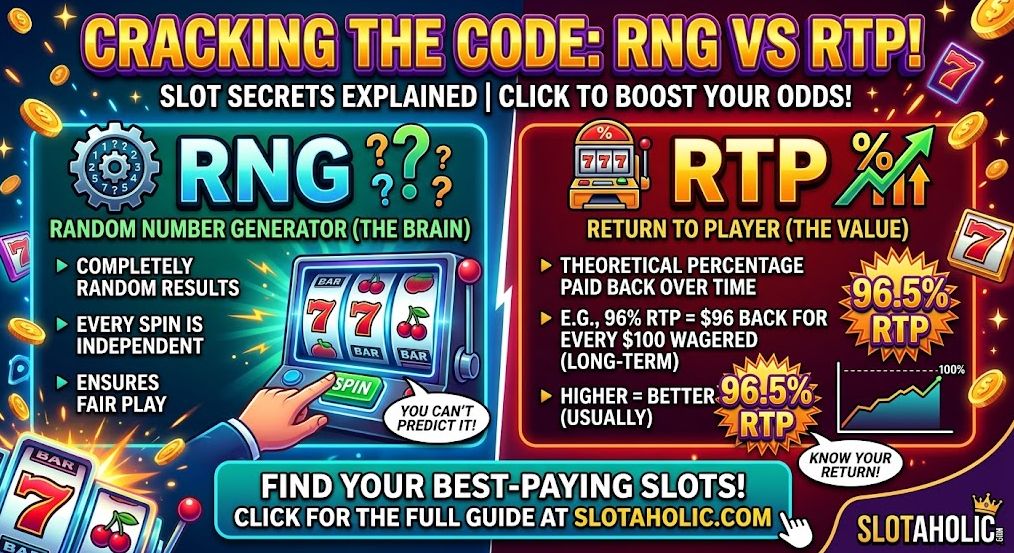
- RTP means Return to Player. It is a theoretical long-term return percentage calculated over a very large number of spins, not a promise of what one person will receive in a session.
- For example, a 96% RTP slot has a theoretical 4% house edge. It does not mean a player who wagers A$100 will get exactly A$96 back, lose only A$4, or win 96% of their spins.
- RTP and volatility are different. RTP describes long-term game maths, while volatility describes how uneven the game may feel. A high-volatility slot can have long quiet periods and deliver much of its potential payout through rare feature wins.
- A higher stake normally increases the value of a payout if a win lands, but it does not normally make the next spin more likely to win. Check individual game rules for jackpot or feature eligibility conditions.
- Legitimate casinos should not secretly alter a certified slot’s RTP for an individual player based on their balance, deposit history, past losses, or previous wins. However, a game title may be offered in different approved RTP configurations across casinos or regulated markets.
- Independent laboratories such as GLI, eCOGRA, and iTech Labs test RNG systems, game mathematics, RTP calculations, payout logic, and technical compliance. Certification supports fairness verification but does not remove the house edge or guarantee a winning session.gaminglabs+1
- A safe slot site should display clear game information, including the provider, paytable, RTP where applicable, bet range, volatility or risk information, feature rules, and withdrawal terms.
- Do not trust sites that promise guaranteed wins, “hot” slots, overdue jackpots, secret timing strategies, or a fee to unlock a withdrawal. These are warning signs, not winning systems.
- The only parts of slot play you can control are your game choice, stake, budget, and time spent playing. You cannot control the RNG, force a bonus, predict a jackpot, or turn a losing streak into a guaranteed win.
- Treat online slots as paid entertainment. Set a limit before playing, choose a stake that fits the budget, never chase losses, and stop when the experience is no longer enjoyable.



How a Slot Decides Your Next Spin Before the Reels Stop
Online slots can look mysterious. Reels spin, symbols land, bonus rounds trigger, multipliers climb, and jackpots appear at random. This visual drama can make it seem as though a slot machine has a memory, reacts to previous spins, or decides when a player is “due” for a win.
That is not how regulated online slots work.
Every spin is determined by a random number generator, usually called an RNG. The RNG creates a result at the exact moment a player presses the spin button. The animated reels that appear afterwards are simply a visual presentation of the result already selected by the game software.
This is why a slot cannot become due for a win. It is also why a winning streak, losing streak, near miss, large deposit, small stake, or previous bonus round does not change the mathematical odds of the next spin.
Understanding this technology helps players separate real slot mathematics from common myths. It also makes it easier to choose legitimate games, interpret RTP percentages correctly, and set realistic expectations before playing.
What an RNG Actually Does
A random number generator is software that continuously produces sequences of numbers. In online casino games, the RNG runs in the background whether a player is spinning or not.
It does not wait for a player to open the game. It does not begin calculating only after a deposit. It does not slow down after a win or speed up after a losing session. It continuously creates possible outcomes at extremely high speed.
When a player presses the spin button, the slot game captures the RNG output at that precise moment. That number is then matched to a specific outcome on the slot’s virtual reels.
The outcome may represent:
- A non-winning spin
- A small line win
- A full-screen symbol combination
- A Wild combination
- A Scatter trigger
- A free-spins round
- A multiplier sequence
- A jackpot feature
- A bonus game
- A progressive jackpot trigger, where applicable
The visual reels then begin to spin. This animation creates anticipation, but it does not influence the result. The game has already selected the final symbol positions.
Think of the process as pressing a button on a digital music player. The song selection is made immediately, even if the screen takes a moment to display the album art. In the same way, a slot’s reels are a visual reveal of an outcome that the RNG already determined.
This does not mean that the casino watches a player’s account and selects a result personally. In a properly licensed and independently tested game, the RNG follows the game’s mathematical design and does not adjust outcomes based on personal balance, previous winnings, country, device type, or emotional state.
What Happens in the Millisecond of a Spin
The exact technical design differs between software providers, but the basic sequence is similar across regulated online slots.
Step 1: The RNG Runs Continuously
The RNG generates values constantly. These values are not limited to the moments when someone is playing. The system continues to produce outputs whether a player is active, offline, reading the paytable, or changing stake size.
This continuous process is important because it means that timing a spin cannot create a reliable advantage. Pressing the button at a particular second, waiting for a certain number of spins, or using a “lucky” pattern does not control which RNG number appears when the game accepts the spin.
Step 2: The Player Presses Spin
When the player presses spin, the game checks whether the selected stake is valid and whether the account has enough available balance. If the spin is accepted, the game captures the current RNG output.
That output may be a very large number. The slot software translates it into a position on each virtual reel.
A physical slot machine has mechanical reel strips with symbols printed around them. An online slot uses virtual reel strips stored in the game software. These digital strips may contain many more symbol positions than the visible reel display suggests.
For example, a screen may show three symbols on one reel, but the virtual reel can contain dozens or hundreds of possible stop positions. Some high-value symbols may appear fewer times than low-value symbols. This is one reason why different symbols have different probabilities.
Step 3: The Game Maps the Number to an Outcome
The slot maps the selected RNG value to the reel positions. The game then checks whether those symbol positions create a winning combination under the paytable and game rules.
The system may also check whether the spin activates a feature, such as:
- Free Spins
- Bonus pick rounds
- Bonus wheels
- Hold-and-Respin rounds
- Cascading wins
- Mystery symbols
- Expanding Wilds
- Progressive jackpot events
- Prize collections
- Feature modifiers
The game does not decide the outcome based on a player’s feelings, betting history, or the number of previous losses. It follows the probability structure built into the approved game.
Step 4: The Result Is Displayed
Only after the mathematical outcome is determined does the game show spinning reels, falling symbols, animations, sounds, and win celebrations.
A bonus round can feel as though it is unfolding live as the symbols land. In reality, the game still uses random processes to determine each event according to its rules. Some features may use separate RNG calls during the bonus, while others may have the full outcome determined earlier. The precise implementation depends on the game supplier and regulator requirements.
From a player perspective, the essential point is the same: the outcome is random, and the animations cannot be influenced after the spin starts.
Virtual Reels and Symbol Probability
Many players assume that every visible symbol on a slot has the same chance of appearing. This is not true.
Online slots use virtual reels. The game software assigns different amounts of virtual reel space to different symbols. Lower-value symbols usually appear more often, while premium symbols, Scatter symbols, bonus icons, and jackpot triggers may appear less often.
Imagine a simplified virtual reel with 100 positions:
- Low-value symbol: 30 positions
- Medium-value symbol: 20 positions
- High-value symbol: 10 positions
- Wild symbol: 8 positions
- Scatter symbol: 2 positions
- Other symbols: 30 positions
The low-value symbol is more likely to land because it appears in more virtual positions. The Scatter is less likely because it appears in fewer positions.
This does not make the game unfair. It is how the slot’s paytable and long-term payout model are designed. A high-value combination can pay more precisely because it is less common.
The game’s rules should explain the symbol values, paylines or ways to win, feature triggers, stake range, and maximum win potential. Regulated casinos and recognised providers normally provide an information button or paytable within the game.
Players should use this information rather than relying on visual impressions. A premium symbol may look prominent on screen but still appear rarely. A bonus icon may appear close to another Scatter, but the appearance of a near miss does not mean the game was about to award a feature.
Why a Slot Is Never Due for a Win
The idea of being “due” is one of the most persistent myths in gambling. It comes from a misunderstanding of independent random events.
Each RNG spin is independent. That means the result of the next spin is not changed by what happened before it.
If a slot has not produced a bonus in 300 spins, that does not mean a bonus is more likely on spin 301. If a jackpot has not appeared for weeks, it does not become mathematically overdue. If a player has lost 10 spins in a row, the next spin does not become more generous to balance the results.
The game does not need to “catch up.”
Consider a coin toss. If a fair coin lands on heads five times in a row, the next toss still has the same chance of landing on heads or tails. The coin has no memory of previous results.
Slots work on the same principle, although their mathematical structure is more complex than a coin toss. Every spin begins as a new random event. The RNG does not remember that you:
- Have been playing for an hour
- Have lost a certain amount
- Have just increased your bet
- Have reduced your bet
- Have almost triggered free spins
- Have seen two Scatter symbols
- Have won a bonus recently
- Have changed games
- Have made a deposit
- Have played in demo mode
- Are using a mobile phone instead of a desktop computer
A losing streak can feel like evidence that a win must be close. A winning streak can feel like evidence that a slot is “hot.” Both feelings are understandable, but neither changes the mathematics of the next spin.
Lucky Streaks and Losing Streaks
Streaks happen because random results naturally cluster.
A random sequence does not always look evenly mixed. It can produce several wins in a short period, followed by several losses. It can produce multiple bonus triggers close together, then a long gap without another feature.
This can feel unusual, but it is a normal property of random outcomes.
For example, a player might experience:
- A bonus round within the first few spins
- Several small wins in a row
- A long sequence of losing spins
- Two feature triggers within minutes
- A large multiplier after a long quiet period
- A large win followed immediately by multiple losses
None of these patterns proves that a slot is hot, cold, tight, loose, or due. A regulated RNG does not attempt to create a fair-looking pattern in the short term. It produces individual random outcomes according to the slot’s design.
This is why short sessions cannot be used to judge whether a slot pays well. A player may have a strong session on a low-RTP game and a poor session on a higher-RTP game. Over a short number of spins, chance has much more influence than the theoretical long-term average.
The only reliable way to view slots is through long-term probabilities, not personal patterns.
RTP Explained in Plain English
RTP means Return to Player. It is a theoretical percentage that describes how much a slot is designed to return to players over a very large number of spins.
For example, a game with a 96% RTP has a theoretical long-term return of 96 units for every 100 units wagered across the game’s full player population and a huge volume of play.
The remaining 4% is the theoretical house edge.
For a 96% RTP game:
This does not mean a player who wagers A$100 will receive exactly A$96 back. It does not mean every 100 spins return 96% of the stake. It does not mean a player will lose only A$4 during a short session.
RTP is not a refund promise. It is not a guaranteed result. It is a long-term mathematical measurement.
A player could wager A$100 and finish with A$0. Another player could wager A$100 and trigger a A$1,000 win. Both outcomes can happen within a game that has a 96% RTP.
The UK Gambling Commission explains RTP as an average achieved over a significant volume of play, rather than a figure that predicts an individual player’s short-term return.
RTP and Volatility Are Different
RTP and volatility are often confused, but they describe different parts of a slot game.
RTP describes the theoretical long-term return.
Volatility describes the pattern of wins and losses a player may experience.
A lower-volatility slot may produce smaller wins more regularly. A higher-volatility slot may produce fewer wins, but it can also have the potential for larger payouts through bonus rounds, multipliers, or rare premium combinations.
Two slots can have the same RTP and feel completely different.
A high RTP does not automatically mean low risk. A game can have a 96% RTP and still be highly volatile. It may return a large share of its long-term payout through rare, high-value events rather than frequent small wins.
Before playing, check both numbers where they are provided. Consider whether the game’s pace and risk profile fit the available entertainment budget.
Can Casinos Change RTP for Individual Players?
A legitimate, regulated casino should not alter the RTP of a properly certified game for one specific player based on their account activity or winnings.
The game version and RTP configuration are normally controlled by the provider and operator under the rules of the relevant jurisdiction. Some slot titles are available in multiple approved RTP versions. For example, one casino may offer a 96% version of a game while another offers a lower configured RTP version where permitted.
This is why players should check the game information panel at the casino they are using. Never assume that every version of a title has the same RTP.
The key distinction is important:
- A casino may offer a different approved RTP version of a slot, depending on the jurisdiction and provider setup.
- A casino should not secretly lower the RTP for one named player because that person won, lost, deposited more, or withdrew money.
If a casino does not provide a game information panel, does not identify its software providers, or does not show clear terms, players should consider that a warning sign.
Regulated games are tested for their mathematical setup. Gaming Laboratories International provides testing and certification services for online gaming systems, including both RNG testing and game-mathematics or RTP testing.
This question needs a precise answer.
A properly licensed and independently tested online slot is not “rigged” in the sense of secretly changing individual results to target a player. It is designed with a house edge, which means the casino has a mathematical advantage over the long term.
The house edge is not hidden manipulation. It is part of the game’s published mathematical design.
For example, a slot with a 96% RTP has a theoretical 4% house edge across an extremely large volume of wagering. The casino does not need to interfere with individual spins to make money over time. The game model already includes the house advantage.
However, not every website offering slot games should be trusted. Unlicensed or scam casinos may use fake software, copied games, manipulated payment systems, false audit badges, or unfair withdrawal practices.
This is why players should distinguish between:
- A regulated slot with a declared RTP and independently tested RNG
- An offshore or poorly regulated casino with unclear oversight
- A scam site with no verifiable operator, licence, game provider, or audit information
The safest option is to use only casinos that are legal and properly regulated where the player lives. Check the casino’s operator details, licence number, game suppliers, testing-lab certificate, terms and conditions, payment rules, and responsible gambling tools before depositing.
For Australian players, online casino games and online pokies are prohibited when offered to people physically located in Australia. Offshore websites that display Australian dollars or market themselves to Australians are not made lawful by those features. Australian players should not use VPNs or false details to bypass restrictions.
For Canadian players, gambling regulation varies by province. Ontario players should verify online casino operators through the iGaming Ontario and Alcohol and Gaming Commission of Ontario framework. Other provinces may use provincial lottery corporation services or different local structures.
How Independent Labs Test RNGs
Independent laboratories help regulators, game studios, and casino operators check that gambling software meets technical and fairness standards.
Recognised testing organisations include:
- Gaming Laboratories International, or GLI
- eCOGRA
- iTech Labs
- BMM Testlabs
The exact testing process depends on the jurisdiction and product, but it can include several important checks.
RNG Randomness Testing
The lab assesses whether the random number generator produces outputs that meet required statistical standards. The objective is not to create a visually even pattern of wins and losses. The objective is to confirm that the RNG behaves randomly and does not create predictable or biased outcomes outside the approved game model.
Game Mathematics Testing
The lab checks whether the slot’s paytable, symbol probabilities, feature rules, and virtual reel structure produce the advertised mathematical return.
This includes checking the RTP configuration, payout distribution, hit frequency where relevant, maximum win logic, bonus features, and jackpot calculations.
Game Rules and Display Testing
The lab may assess whether the game displays key information correctly, including stake values, wins, paylines or ways to win, paytable rules, bonus conditions, and responsible gambling messages.
Security and System Testing
Testing may also include technical security controls, data integrity, game version control, platform behaviour, and communications between the casino, player interface, game server, and payment systems.
iTech Labs provides RNG testing and certification services for online casino games, with the stated purpose of supporting fairness, transparency, and compliance with regulatory expectations.
How to Check a Slot’s Fairness
Players cannot personally inspect a game’s source code, but they can carry out practical checks before playing.
Check the Casino Licence
Find the operator name, licence number, and regulator in the casino footer or terms page. Verify the information on the regulator’s official register. The legal entity and casino website domain should match.
Check the Game Provider
Recognised providers normally identify themselves in the game lobby and inside the game information panel. Look for established studios rather than anonymous, untraceable game suppliers.
Open the Paytable
Read the game rules before staking real money. Check the RTP, volatility, bonus conditions, maximum win, symbol values, bet range, and jackpot mechanics.
Verify Audit Information
Look for testing-lab references or certificates. If a casino displays a seal, click it. A genuine seal should lead to a verification page on the laboratory’s official website, not simply to another casino page or a copied image.
Review the Withdrawal Terms
A fair game is not enough if the casino makes cashing out impossible. Check the minimum withdrawal amount, maximum withdrawal limits, processing time, verification process, payment method restrictions, and bonus-related rules.
Test Customer Support
Ask a simple question before depositing. For example: “Which RTP version of this game is offered to players in my location?” or “What documents are required for a first withdrawal?” A reliable casino should provide a direct and consistent answer.
Common RNG Myths Debunked
“The slot knows I have been losing.”
A regulated RNG does not track losses in order to reward or punish a player. Every accepted spin is a new random event.
“A bigger bet improves my odds.”
A larger stake may increase the value of a payout if a win occurs, but it does not normally improve the probability of landing a winning outcome. Check the paytable because some jackpots or features may have specific eligibility rules.
“I saw two Scatters, so the third one was close.”
A near miss is not evidence that the game was about to trigger a bonus. The outcome was randomly selected, and two visible Scatters do not make another Scatter more likely on the next spin.
“Changing games resets my luck.”
Changing games does not reset anything because there is no personal luck score being tracked by regulated RNGs. The next game also uses its own random outcome process.
“I should stop after a win because the game will take it back.”
A slot does not become less likely to pay simply because a player has won. However, continuing to gamble increases total exposure to the house edge, so stopping after reaching a personal limit can still be sensible.
“The casino can see my balance and stop me winning.”
Legitimate regulated games should not target individual players by changing outcomes based on their balance. A casino should rely on the approved game mathematics, not personalised manipulation.
A Smarter Way to Play
Understanding RNGs and RTP does not create a winning system. It creates a clearer approach to gambling.
Use these practical rules:
- Treat slots as entertainment, not income.
- Set a total spend limit before opening a game.
- Choose a stake that allows the budget to last for the planned session.
- Check the RTP and volatility before playing.
- Read the paytable and feature rules.
- Do not chase a bonus because it feels overdue.
- Do not increase the stake to recover losses.
- Avoid treating a streak as a prediction.
- Use deposit limits, time-outs, or self-exclusion tools if needed.
- Stop when gambling is no longer enjoyable.
A player can control stake size, game choice, time spent, and spending limits. A player cannot control the RNG outcome.
That distinction is the foundation of responsible slot play.
Final Verdict
Online slots do not remember your past spins, react to losing streaks, or become due for a bonus. A regulated game uses an RNG to determine each result independently at the moment the player starts the spin.
The reels, sounds, and animations that follow are part of the presentation. They build anticipation, but they do not influence the outcome.
RTP explains the game’s theoretical long-term return, while volatility explains how uneven the short-term experience may feel. Neither figure can tell a player what will happen in the next spin or the next session.
The safest way to approach slots is to choose legally available, properly regulated games, verify the casino and provider, read the game information panel, understand the RTP and volatility, and use a strict entertainment budget.
There is no hot slot, cold slot, lucky timing system, or guaranteed bonus strategy. There is only random probability, game mathematics, and the personal limits a player sets before pressing spin.
FAQs
What is an RNG in online slots?
An RNG, or Random Number Generator, is the software that selects the outcome of each online slot spin. It produces random values continuously, and the game captures one of those values when you press the spin button. The selected value is then mapped to a set of virtual reel positions, symbols, and any applicable feature result.
Is the slot result decided before the reels finish spinning?
Yes. In a regulated online slot, the game normally determines the mathematical outcome as soon as the spin is accepted. The spinning reels, sound effects, falling symbols, and win animations reveal the selected result, but they do not change it. Stopping or tapping the reels early only shortens the animation; it does not alter the outcome.
Are online slots ever due for a win?
No. Online slot spins are independent random events. A long losing streak does not make a bonus, free-spins round, jackpot, or big win more likely on the next spin. Likewise, a recent win does not mean the game has become cold. The RNG does not remember previous spins, deposits, stake changes, or account balances.
What does RTP mean in slots?
RTP means Return to Player. It is a theoretical long-term percentage that describes how much a game is designed to return as prizes across a very large volume of wagers. For example, a 96% RTP game has a theoretical 4% house edge. It does not mean you will receive exactly A$96 for every A$100 wagered, and it cannot predict the result of an individual session.
What is the difference between RTP and volatility?
RTP describes a slot’s theoretical long-term return, while volatility describes how the payout pattern may feel during play. Lower-volatility games may produce smaller wins more often. Higher-volatility games may have longer losing stretches but offer stronger potential through rare bonus rounds, multipliers, or premium-symbol combinations. Two slots can have the same RTP but deliver very different short-term experiences.
Can a casino change a slot’s RTP for one player?
A legitimate regulated casino should not change a certified game’s RTP specifically for an individual player because they have won, lost, deposited, or withdrawn money. However, some slot titles are released in more than one approved RTP configuration, and casinos may offer different versions depending on their jurisdiction or provider agreement. Check the in-game help screen or paytable to see the RTP version currently available to you.
How are online slot RNGs tested?
Independent testing laboratories can test a slot’s RNG, source code, virtual-reel mapping, payout calculations, game rules, and RTP model before the game is released. The testing aims to confirm that RNG output is statistically random and unpredictable, that the conversion from random values to game outcomes does not introduce bias, and that the declared RTP matches the tested game version. Certification does not guarantee a personal win; it confirms that the tested game should operate according to its approved mathematical design.
Sources
- Gaming Laboratories International: Digital iGaming testing and certification
- iTech Labs: iGaming testing, RNG audits and certification
- UK Gambling Commission: Return to Player explained
- iGaming Ontario: Operator directory
- Australian Communications and Media Authority: Online gambling services
- eCOGRA: Independent testing and player-protection standards